Feels-like temperature, UV index and air quality: a practical daily guide
Pubblicato il 2026-08-16 · 10 min di lettura
Temperature is the most consulted value in any forecast, but it is rarely the most important one for health. Three other indicators — feels-like temperature, UV index and air quality — say far more about the real risk of a day outdoors. This guide explains how each is calculated, what its ranges mean, and how to turn that into concrete decisions.
Feels like: when the body disagrees with the thermometer
The human body holds its core near 37°C by burning energy and shedding the excess heat to the environment. The feels-like value estimates how easy or hard that shedding currently is. It is not a presentation gimmick: it is the indicator that best predicts heat stress, exhaustion and hypothermia.
In heat, humidity rules
When air temperature approaches skin temperature (around 35°C), the only efficient cooling route left is sweat evaporation. And evaporation requires room in the air to accept more vapour — that is, it depends on relative humidity.
At 32°C with 40% humidity it feels close to 33°C: sweat evaporates well and the body copes. At the same 32°C with 85% humidity, it feels near 45°C, because sweat simply runs off without evaporating. That is why humid heat waves kill more people than drier heat waves at higher temperatures.
Attention ranges in heat:
- 27°C to 32°C felt — fatigue possible with prolonged exposure and physical activity.
- 32°C to 41°C — cramps and heat exhaustion likely under sustained effort.
- 41°C to 54°C — high risk of heat stroke; intense activity should stop.
- Above 54°C — heat stroke imminent even at rest in the shade.
In cold, wind rules
In the cold the logic inverts. The body maintains a thin layer of warmed air against the skin that acts as insulation. Wind strips that layer continuously and heat loss spikes. At 5°C with calm air it feels like 5°C. At 5°C with 30 km/h wind it drops to about -1°C.
The practical risk is frostbite: with a wind chill below -15°C, exposed fingers and ears can be injured in under 30 minutes; below -30°C, in under 10.
How to use it
For training and outdoor work, plan by the feels-like value rather than the temperature. If the heat index passes 32°C, cut intensity, drink 200 to 300 ml every 20 minutes, and shift the session to early morning or late afternoon. In the cold, layer up and protect extremities — the wind chill already embeds the wind you will actually face.
UV index: invisible, silent and cumulative
The ultraviolet radiation reaching the ground splits, for practical purposes, into UVA and UVB. UVB drives sunburn and direct DNA damage in skin cells. UVA penetrates deeper, is the main cause of premature ageing and also contributes to cancer risk. The UV index combines both on an open scale starting at 0.
What the scale asks of you
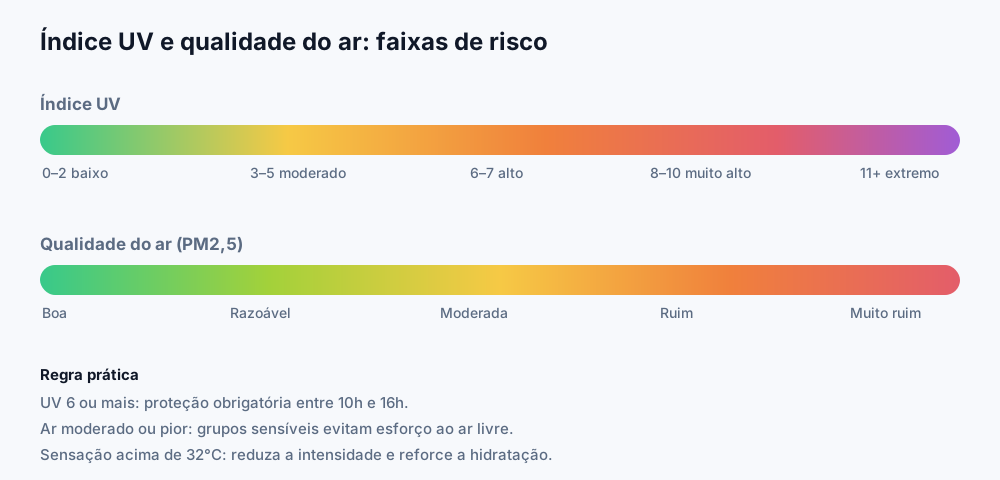
- 0 to 2 — low. No protection needed for most people.
- 3 to 5 — moderate. SPF 30 sunscreen, UV-blocking sunglasses and shade at midday.
- 6 to 7 — high. Shirt, wide-brimmed hat and reapplication every 2 hours.
- 8 to 10 — very high. Fair skin burns in 15 to 20 minutes. Avoid sun from 10 a.m. to 4 p.m.
- 11 or above — extreme. Burns in under 10 minutes. Exposure discouraged.
Factors almost nobody accounts for
Clouds protect less than you think. Thin cover lets through 80% or more of UV radiation, and scattered clouds can briefly raise the index through edge reflection. Sunburn on overcast days is common for exactly this reason.
Altitude increases exposure by about 10% per 1,000 metres, because less atmosphere filters the radiation. A hike at 2,500 metres exposes skin to an index 25% higher than the same latitude at sea level.
Surfaces reflect. Snow reflects up to 80% of UV, dry sand around 15%, sea foam up to 25%. Sitting under a beach umbrella still means receiving radiation bounced off sand and water.
Ordinary glass blocks UVB but not UVA. Professional drivers often show more skin damage on the window side of the body.
You can check the current UV index and today's peak for any city — for instance the weather in Miami or the weather in Dubai, where the index exceeds 11 for much of the year.
Air quality: the pollutant that matters fits inside a hair
The air quality index condenses several pollutants into one number, but the lead actor is nearly always fine particulate matter, PM2.5 — particles under 2.5 micrometres, about thirty times finer than a human hair. That size is the problem: they bypass upper-airway defences, reach the alveoli and enter the bloodstream.
Main sources are diesel vehicle combustion, wildfires, industry and — in many regions — domestic biomass burning. Ground-level ozone, nitrogen dioxide and sulphur dioxide complete the index.
Bands and what to do in each
- Good — outdoor activity fine for everyone.
- Fair — very sensitive individuals may notice mild irritation under prolonged effort.
- Moderate — sensitive groups (asthma, COPD, heart disease, children, older adults, pregnancy) should reduce intense outdoor effort.
- Poor — sensitive groups should avoid outdoor activity; everyone else should ease intensity.
- Very poor or extremely poor — everyone should avoid outdoor exercise; close windows and run a purifier if available.
A frequently forgotten detail: exposure during exercise is far greater than at rest. Running moves 10 to 15 times more air through the lungs and shifts breathing to the mouth, which does not filter like the nose. One hour of running in poor air can match, in inhaled dose, several hours of seated exposure.
When air gets worse
There are predictable patterns. Temperature inversions on cold winter mornings trap pollutants near the ground and spike the index between 6 a.m. and 9 a.m. Dry seasons with regional wildfires raise PM2.5 for weeks, even hundreds of kilometres from the fires. Rain washes the atmosphere and usually drops the index within hours. Strong wind disperses — unless it is carrying smoke from elsewhere.
Groups that need more care
Risk thresholds are not equal for everyone. Some groups reach the stress point well before the average:
- Young children have more surface area per unit of weight, sweat less and depend on adults for hydration. They heat up and dehydrate faster.
- Older adults lose thirst sensitivity and sweating capacity, and often take medication (diuretics, beta blockers, anticholinergics) that interferes with thermoregulation.
- Pregnant people run a higher basal temperature and increased blood volume, which narrows the thermal margin.
- People with asthma or COPD react to PM2.5 concentrations that would not affect a healthy lung, and cold dry air is an additional bronchospasm trigger.
- Outdoor workers — construction, delivery, agriculture — accumulate exposure over hours, multiplying both thermal effect and UV damage.
Hydration: how much and when
The "two litres a day" rule ignores climate and effort. In moderate activity with a heat index above 30°C, sweat loss can exceed one litre per hour. Practical references:
- Drink 400 to 600 ml in the two hours before a long outdoor session.
- During effort, 150 to 250 ml every 15 to 20 minutes, even without thirst.
- Beyond an hour of intense sweaty activity, include electrolytes — replacing water alone dilutes sodium and can cause hyponatraemia.
- Urine colour is the most reliable home indicator: pale yellow means adequate hydration.
Sunscreen: what practice shows
Quantity matters as much as the factor. Real-world application studies show most people use a quarter to half the laboratory dose used to certify SPF — which cuts effective protection disproportionately. For an adult body the reference dose is close to 30 ml, roughly a shot glass.
Other points that change the outcome: apply 15 to 30 minutes before exposure, reapply every 2 hours and always after swimming or heavy sweating, and do not forget ears, the back of the neck, the tops of the feet and the scalp on thinning hair. Tightly woven clothing and wide-brimmed hats protect better than any cream because they do not depend on reapplication.
What a wearable can and cannot tell you
Watches and phones increasingly display their own temperature and air data. Skin-contact sensors read a mixture of body heat and ambient air, so a wrist reading is rarely comparable to a weather station. Phone barometers, by contrast, are genuinely accurate and are already used by some services to improve local pressure analysis. Treat wearable temperature as a rough trend and the published forecast as the reference.
Combining the three indicators
In practice the three are rarely bad at once — and that is exactly the useful information. Typical scenarios:
- Hot, dry, sunny day: moderate heat index, extreme UV, generally good air. The threat is radiation — protect skin and hydrate.
- Hot, muggy, overcast day: high heat index, moderate UV, variable air. The threat is heat stress — cut effort intensity.
- Cold, calm winter morning: mild feels-like, low UV, often poor air from inversion. The threat is pollution — postpone the run until after 10 a.m.
- Wildfire day with whitish sky: moderate UV from smoke, very poor air. The threat is respiratory, and the "cloudy" look is deceptive.
Acclimatisation: the body learns
Someone moving to a hotter region suffers more in the first weeks and then adapts. Acclimatisation is real and measurable: within 7 to 14 days of regular exposure the body begins sweating earlier, in greater volume and with less sodium loss, and the heart works at a lower rate for the same effort. The effect fades within two to three weeks without exposure. This is why the season's first heat wave usually causes more hospital visits than more intense waves later in summer.
Indoor air deserves attention too
Most people spend the large majority of the day indoors, where the outdoor index is only part of the story. Fine particles infiltrate buildings readily: with windows closed, indoor PM2.5 typically settles at 30% to 70% of outdoor levels, and the fraction rises in older buildings. Cooking on gas, burning candles, vacuuming without a HEPA filter and even lighting incense can push indoor readings above the street outside.
Practical measures are unglamorous but effective. On poor-air days, keep windows shut during the peak hours and ventilate later, when the index drops. Use the extractor hood every time you cook. If you run a purifier, size it for the room volume and replace filters on schedule — a saturated filter is close to no filter at all. And remember that carbon dioxide build-up in a sealed room causes drowsiness and poor concentration well before any pollutant does, so the goal is timed ventilation rather than permanent sealing.
Myths that get in the way
"It's cloudy, I don't need sunscreen." Thin cloud transmits most UV radiation. The index decides the need, not the look of the sky.
"If it's not hot, I won't dehydrate." In cold dry air, respiratory water loss is significant and thirst is blunted — dehydration on winter hikes is common.
"You can smell polluted air." PM2.5 is odourless and invisible at concentrations that already harm health. Only measurement tells you.
"A fan fixes any heat." Above 35°C with high humidity, a fan moves air hotter than the skin and can worsen heat stress in older adults.
Reading the numbers together over a week
Single readings are useful, but patterns are more useful still. A week where the overnight minimum never falls below 26°C is far more dangerous than a single 40°C afternoon, because the body relies on cooler nights to recover. Likewise, three consecutive days of moderate air quality during a wildfire episode carry a larger inhaled dose than one afternoon of poor readings.
When you look at a seven-day view, scan for three things: whether nights cool down, whether the UV peak stays above 8 on consecutive days, and whether any day combines high humidity with a high afternoon temperature. Those combinations, rather than isolated peaks, are what turn an uncomfortable week into a risky one.
Suggested routine
- The night before, check tomorrow's high, low and UV peak.
- In the morning, check feels-like and air quality before setting the time and place for exercise.
- Before heading out, read the hourly rain curve to find the dry window.
- If wildfires are active nearby, treat the air index as the dominant criterion.
To continue, see how to read every number in a forecast and learn why forecasts get it wrong. Or check the 7-day forecast for Toronto.